
Emergency Air Duct Cleaning Near Me: What Northridge Homeowners Should Do First
If you’re searching “emergency air duct cleaning near me” in Northridge, the most important thing to understand is this: a genuine duct emergency is rare, but when it happens, the first 30 minutes determine whether you contain the problem or spread it through every room. True emergencies involve smoke infiltration, sewage or water intrusion, or biological contamination like rodent activity. For everything else, a standard appointment within 48 to 72 hours is typically fine. If you’d rather not sort through the details, call (833) 968-4871 and we’ll help you assess the situation over the phone.
What Actually Counts as an Air Duct Emergency?
Most calls we get labeled “emergency” are actually urgent-but-not-critical situations. Dust buildup, musty odors, or a dusty house after a remodel are legitimate problems, but they don’t require shutting down your HVAC system at midnight. Here’s the distinction that matters.
A genuine duct emergency falls into one of three categories:
- Smoke infiltration: Wildfire smoke or an in-home kitchen fire pushes particulate into the return air stream. The ducts become a reservoir for fine soot and odor-causing compounds that recirculate every time the blower runs.
- Water or sewage intrusion: A backed-up condensate line, a plumbing failure above a return plenum, or flooding that reaches ductwork introduces moisture into a dark, temperature-controlled environment. That’s a mold incubation chamber, not a pipe.
- Biological contamination: Rodent nesting, droppings, or a dead animal inside ductwork. This is the one we see most often in older Northridge homes with raised foundations and accessible crawl spaces.
Anything outside these three, and you can probably schedule a routine cleaning. The problem is that homeowners don’t know how to tell the difference, and by the time they figure it out, the HVAC system has already done the damage. The blower moves air through every register at 400 to 700 cubic feet per minute. If there’s contamination at the return, you’ve distributed it through the entire home within minutes.
Step One: Shut Down Air Circulation Before Anything Else
Here’s the sequence we walk Northridge homeowners through on emergency calls, and it’s the same advice whether you hire us or someone else. The goal is to stop the HVAC blower from moving contaminated air before you even think about scheduling a cleaning.
- Turn off the thermostat. Set the system to OFF, not AUTO, not COOL, not HEAT. OFF means the blower won’t kick on for any reason.
- Switch the blower to manual off. Some Northridge homes have a thermostat with a FAN ON setting. Make sure that’s not running. If the blower is currently running, turning the thermostat to OFF stops it.
- Kill power at the breaker. Look for the HVAC or furnace breaker in your panel. This is the step most people skip, and it’s the one that protects you if someone bumps the thermostat or a smart thermostat runs a scheduled cycle. Flip the breaker and tag it so nobody turns it back on.
- Close the supply registers in the affected rooms. This traps what’s already in the branch runs from spreading further while you wait for a technician.
If you have a zoned system, which is common in larger Northridge homes built after 2000, check the zone control panel as well. Some zone dampers default to open when the system loses power, so don’t assume the damper positions are protecting you. The breaker is the only guaranteed stop.
One thing we’ve learned from hundreds of duct inspections: the worst contamination spreads happen when homeowners run the fan to “air things out” after noticing an odor. An odor means particles are in the airstream. The fan is the distribution mechanism. Turn it off first, investigate second.
What to Document Before Anyone Touches Anything
This section matters most for Northridge homeowners dealing with wildfire smoke or insurance-eligible water damage. Documentation taken in the first hour is the difference between a covered claim and a denied one. And it protects you from contractors who might otherwise overstate the scope.
Take photos before any cleaning begins:
- Register and grille surfaces: Wipe one white cloth across the vent cover and photograph the residue. This establishes contamination was present at the point of entry.
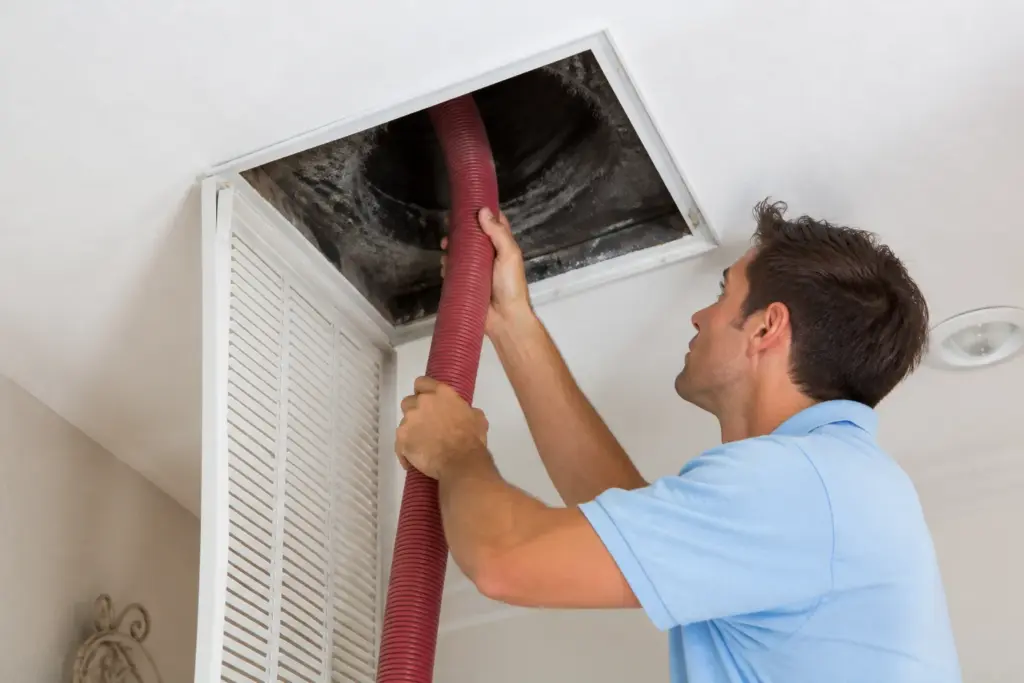
- Return air cavity: Remove the return grille (usually two screws or spring clips) and photograph the inside of the plenum before anything is disturbed. This is where contamination concentrates first.
- Filter condition: Pull the filter and photograph it in place. A filter black with soot is evidence of smoke infiltration. A filter with rodent droppings on the downstream side is evidence of nesting in the ductwork.
- The source point: If you found rodent nesting in a register or water staining around a supply boot, photograph that exact location with something for scale, like a quarter.
Don’t start cleaning registers or running sanitizing foggers before photos exist. We’ve watched homeowners scrub away the exact evidence their insurance adjuster needed. Photos on a phone, with time stamps enabled, are enough. Then put the grilles back on and leave things alone until a professional arrives.
How to Evaluate an “Emergency” Duct Cleaning Company
A company that answers the phone at 11 p.m. is not the same as a company equipped to handle biological or smoke contamination. You need to ask a specific question: What equipment are you bringing for this type of contamination?
Here’s what the answer tells you:
- If they mention HEPA extraction: Legitimate. Equipment like the Nikro HEPA-filtered vacuum systems we run captures particles down to 0.3 microns. That matters because the fine particulate in smoke and rodent droppings pass through standard vac filters and get exhausted back into the room.
- If they mention negative air or containment: Legitimate. Abatement Technologies negative-air machines create a pressure differential that pulls air into the duct system rather than letting contaminants drift into the living space during agitation. For smoke and biological work, we set up containment barriers and run negative air. For routine dust cleaning, it’s overkill. Knowing the difference is what separates diagnostics from guesswork.
- If they mention “sanitizing” as the primary method: Red flag. Fogging or misting products have their place as a secondary step, but they don’t remove the physical material. If a company leads with “we’ll fog your ducts,” they’re selling you a band-aid.
Ask what happens after the cleaning. A real answer includes inspection, maybe a camera scope of the main trunk line, and verification. Here’s where it matters that the company can actually repair. Emergency contamination rarely leaves ductwork pristine. Rodents chew through flex duct. Water delaminates the inner liner of rigid duct. Smoke odors embed in porous insulation. If the cleaning company can’t perform Air Duct Repair in Northridge, then they’re going to clean what’s left and walk past the damage. That leaves you with a system that still pulls attic air or crawl space air through the gaps they ignored.
The Remediation Sequence: Why Cleaning Alone Doesn’t End the Job
Once the contamination is removed from the duct interior, the job is only half done. The sequence matters, and skipping steps means the problem returns in weeks, not years.
First, the source: Rodents don’t leave because their nest was vacuumed out. The entry point in the crawl space foundation or the disconnected return branch has to be sealed or they’ll be back by the next cold snap. We pulled a rat’s nest out of a return trunk over in the Granada Hills-adjacent side of Northridge last winter where the real problem was a three-inch gap around an old furnace platform penetration. Cleaning was fine. Sealing the gap closed the file.
Second, the coil and blower: If smoke or biological particulate traveled through the system, it didn’t stay only in the ducts. The evaporator coil is wet during cooling season and captures fine particles like a filter. The blower wheel holds dust in every blade cup. If these aren’t cleaned or at minimum inspected, the first cooling cycle recirculates what you just paid to remove.
Third, the filtration: For homes dealing with ongoing allergies or wildfire smoke season in the San Fernando Valley, the filter is the last line of defense. This is why we work with Honeywell and Aprilaire whole-home filtration systems. A 1-inch fiberglass filter catches large dust. A 4-inch media cabinet rated MERV 11 or better catches what actually irritates lungs. After an emergency event, upgrading filtration is the difference between a clean system and a clean home.
Fourth, the return air pathways: Contamination enters through returns, not supplies. If a return plenum was affected, the wall cavity or chase it runs through may also hold residue. A competent technician checks the path, not just the pipe.
When to Call a Pro vs. When You Can Wait
If you’ve found soot inside a register after a nearby wildfire, call today. If you’ve found rodent droppings inside a vent, call today and keep the system off. If you smell sewage from the return when the fan runs, call today, shut the system down at the breaker, and open windows. These are not negotiable DIY situations.
If you’ve got dust accumulation after a remodel, a slightly musty smell when the AC first kicks on, or you simply can’t remember the last time the ducts were cleaned, a standard appointment will serve you fine. Schedule it, continue using your system, and don’t treat it as an emergency.
And if you’ve recently had a fire or water event, the documentation you took in that first hour matters more than the speed of the service call. A company that shows up with the right containment and extraction equipment, asks about source elimination, and has repair capability is worth a same-day fee. One that shows up with a shop vac and a leaf blower, not so much. That’s the difference between professional duct work and a performance.
Related services in Northridge: our Air Duct Cleaning in Northridge covers routine cleaning with Rotobrush agitation and HEPA extraction. For fire-safety issues around dryer exhaust, see Dryer Vent Cleaning in Northridge. And when duct work is damaged, disconnected, or degraded, our Air Duct Repair in Northridge service handles the fix, not just the clean. If you’re at our main page and want the full picture of what we do across the Valley, that’s our Air Duct Cleaning Northridge home.
The Bottom Line
An air duct emergency doesn’t start with the phone call. It starts with the 30 minutes after you discover the problem. Turn the system off, photograph what you found, and only then start calling. Know whether you’re dealing with smoke, water, or biological contamination, because each requires a different containment response. And when you choose a company, ask what equipment they’re bringing and whether they can repair what they find. The goal isn’t just a clean duct. It’s a clean, repaired, and sealed system that won’t recirculate the same problem in a month.
If you’re in Northridge and need help assessing a situation in your ductwork, Air Duct Cleaning Northridge offers free estimates. Call (833) 968-4871 and we’ll talk through what you’re seeing before you spend a dollar.
Frequently Asked Questions
How much does emergency air duct cleaning cost in Northridge?
Emergency duct cleaning in Northridge typically runs $600 to $1,400 depending on the contamination type, system size, and whether containment and negative air are required. Smoke and biological events cost more than routine dust cleaning because of the extra equipment and disposal protocols involved. It’s cheaper than a denied insurance claim because you scrubbed the evidence. Call (833) 968-4871 for a precise estimate.
Can I run my HVAC system after a small kitchen fire?
No. Soot is not just a stain. It’s fine particulate that your blower will distribute through every supply run in the home within minutes. Turn the system off at the thermostat and breaker, photograph the registers and filter, and leave it off until a professional with HEPA extraction equipment has inspected the system.
How do I know if rodents are in my ductwork?
Listen for scratching sounds when the system is off. Look for droppings around registers or the return grille. Smell for a musky, urine-like odor that intensifies when the blower first kicks on. If any of these are present, shut the system down and inspect. Rodents in flex duct often mean the duct itself is damaged and will need repair, not just cleaning.
Does insurance cover air duct contamination after a wildfire?
Often yes, but coverage depends on documentation. Photos of soot at the registers, a filter showing visible particulate, and ideally a written inspection from a professional are what adjusters look for. Take photos before any cleaning starts. If you’re not sure what your policy covers, document first, ask your adjuster second, and schedule the cleaning only after you know the sequence.
Written by the team at Air Duct Cleaning Northridge, serving Northridge since 2014.
Need Air Duct Cleaning Help?
Call Air Duct Cleaning Northridge - licensed & insured, with free written estimates in Northridge.
(833) 968-4871